Why do chip fab workers wear full bunny suits?
Chip fab workers are covered head to toe because people are a cleanroom's biggest source of dirt. Particles, cleanroom classes and gowning, explained.
In photos from inside a chip fab, everyone wears the same coverall, hood and face mask, with only their eyes showing. The outfit is a cleanroom suit, nicknamed a "bunny suit". It doesn't protect the person wearing it. It protects the wafers, and what it keeps out is the person.
People are the biggest source of dirt in a cleanroom
The human body sheds all the time: skin flakes, hair, fibers from clothing, tiny droplets from breathing and talking. You can't see them, but the numbers are huge. University cleanroom rules often quote figures like these: a person standing still gives off more than a hundred thousand particles larger than 0.5 micrometers every minute; walking, more than a million.
The tools, pipes and floors in a cleanroom can all be designed to stay clean. People are the one thing that comes and goes every day. That's why most cleanroom rules are really about people.
Why one invisible particle can ruin a chip
A human hair is a few tens of micrometers across. A 0.5-micrometer particle is about a hundred times thinner, far too small to see. But the line width of the circuits on a chip is measured in nanometers, many times smaller still than that particle.
A particle landing on a wafer is like a pebble landing on a page halfway through printing: it can block the exposure and break a line, or bridge two lines that should stay apart and cause a short. A wafer holds many chips, and one particle can kill one of them. That's lost yield.
How clean is a cleanroom?
Today cleanrooms are usually classified with the international standard ISO 14644-1, from ISO 1 (cleanest) to ISO 9, by how many particles above a given size are allowed per cubic meter of air.
| Class | Max particles ≥ 0.5 µm per m³ | Old name |
|---|---|---|
| ISO 5 | 3,520 | Class 100 |
| ISO 6 | 35,200 | Class 1,000 |
| ISO 7 | 352,000 | Class 10,000 |
| ISO 8 | 3,520,000 | Class 100,000 |
"Class 100" comes from the old US standard: no more than 100 particles of 0.5 micrometers or larger per cubic foot of air, roughly ISO 5. The most critical spots in a chip fab are often held to an even stricter level than ISO 5. For comparison, a cubic meter of ordinary outdoor air can hold tens of millions of particles that size.
How the air stays clean
- The ceiling is a wall of filters: air passes through HEPA filters (at least 99.97% of particles at 0.3 micrometers, the hardest size to catch) or even finer ULPA filters and blows down from the ceiling.
- Air flows top to bottom: clean air comes down from above and is pulled out through the floor or near the walls, carrying particles down and away instead of letting them float.
- Positive pressure: the cleanroom is kept at slightly higher air pressure than outside, so when a door opens, air flows out and dust from outside has a hard time getting in.
How to put on a cleanroom suit: top down, gloves last
Every fab and university lab has its own order, but the gowning procedures that university cleanrooms publish share a few things:
- Take off linty outer clothes and tuck all your hair into a hair net.
- Put on a face mask, then the hood.
- Step into the coverall, tuck the hood's skirt into the collar, and zip up.
- Pull on the boot covers.
- Gloves go on last (and often safety glasses).
Why top down? Your head sheds the most particles, and particles fall. Cover the head first, then the body and feet, and put gloves on last so your hands don't touch anything else while you dress. Taking it off goes roughly in reverse.
Many cleanroom entrances also have an air shower: a small room whose two doors can't open at the same time, where nozzles blow filtered air at high speed while you raise your arms and turn around, blowing particles off the suit before you go in. Makeup, ordinary paper and anything that sheds aren't allowed in either.
Does a suit stop all particles?
No. A cleanroom suit greatly reduces what a person gives off, but not to zero: walking in a suit still pumps particles out through the gaps. That's why people in a cleanroom walk instead of running and move slowly, and why wafers ride in sealed boxes (FOUPs) carried overhead by an overhead hoist transport whenever possible. All these rules share one reason: the less people come near the wafers, the better.
In fab24hr
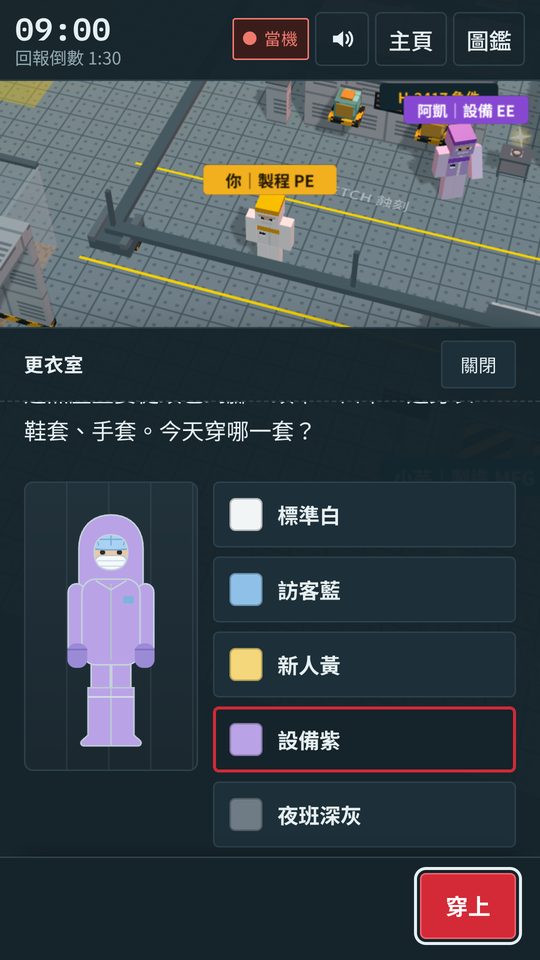
In fab24hr, Manufacturing and the equipment engineer change at the lockers before walking from the office into the cleanroom, in order: hair net, mask, hood, coverall, boot covers, safety glasses, gloves. Once changed, the 3D characters wear the hood, glasses, mask, boot covers and blue gloves, and take them off when they walk back to the office. The companies and people in the game are fictional; the cleanroom rules follow procedures published by universities and research labs. And in that suit, mind you don't trip.
In fab24hr, before you walk from the office into the cleanroom, you change into a cleanroom suit at the lockers.
Play as Manufacturing, starting in the gowning roomMore articles
The life of a chip: a new main story that follows one chip from the R&D line to someone's hands
Why is the lithography area in a chip fab yellow?
Why do chip fabs run 24 hours a day?
- What is fab24hr?: the two ways to play, the four shifts, common questions, sources
- The life of a chip: how chips are made: tape-out, pilot run, mass production, wafer test, packaging, shipping
- A day in the life of a fab engineer: who does what (PE, EE, PIE, manufacturing), and the day hour by hour
- Who works in a chip fab: technicians, manufacturing, process, equipment, litho, facilities, integration, R&D, the chief, the vendor, and test and packaging at the test-and-assembly house: each role's day
- Chip fab jargon in plain English: MO, Hold, Q-time, OCAP and the rest, one plain sentence each
- fab24hr in the classroom: 20- and 40-minute lesson plans, one chapter of the main story per lesson, discussion questions, devices and privacy
- About and press kit: trailer, gameplay clips, descriptions and key facts