Why do chip fabs run 24 hours a day?
Chip fabs run around the clock and engineers get calls at 3 a.m. Why fabs rarely stop, and how shifts and on-call work, in plain English.
The lights in a chip fab never go off. On holidays, during storms, at three in the morning, there are people in the cleanroom and the tools are running. People who work in fabs talk about shifts, nights and rotations, and engineers talk about "getting called at night". Why can't a fab just lock up at the end of the day like an ordinary factory?
Reason one: the tools are too expensive to sit idle
A fab is packed with extremely expensive tools. Once a tool is bought, it depreciates every day whether it's used or not: its cost is spread over time, and as newer processes arrive, it slowly becomes outdated.
The math is simple. With the same investment, running wafers 24 hours a day instead of 8 means the tool's depreciation spread over each wafer is about three times smaller. So fabs try to keep tools working as much as possible, and they watch numbers like availability every day: how much of the time a tool is usable and running.
Reason two: a wafer takes months to finish
From the moment a wafer starts on the line until it leaves the fab, it goes through hundreds of steps: coating, exposure, etch, deposition, cleaning, measurement, layer after layer. The whole trip usually takes several weeks up to about three months, before the wafer goes on to assembly and test.
That means at any moment, thousands of wafers are on the line at once, each sitting at a different step. They spend most of their time queuing in front of tools. If the whole line stopped every night, every wafer would take even longer, and deliveries would slip with them.
Some steps also have a time limit, called Q-time: after one step finishes, the next must happen within a set time, because a wafer surface left too long reacts with the air and changes. That can't wait until tomorrow morning.
Reason three: once stopped, hard to restart
Many tools can't simply be switched off and on again:
- High-temperature furnaces are heated very hot. Heating and cooling them over and over wears out the furnace itself, so even with no wafers inside, they often idle at a lower but still warm temperature instead of shutting down.
- Vacuum chambers: many processes run in a vacuum. Once a chamber is opened to air, it takes a long time to pump down again and confirm it's clean before wafers can go back in.
- Processes need to be stable: after a tool has stopped or been repaired, it runs test wafers to confirm its results are normal before product goes back in. That's a qual run and the tool release.
The same goes for the whole building: the cleanroom air handling, the ultrapure water, the gases and the chemical supply all run 24 hours. Restarting isn't flipping a switch; it's a whole round of re-checking.
Then why not load every tool to 100%?
It sounds contradictory, but fabs usually don't schedule their busiest tools to 100%. It's the same as a checkout line: the closer the cashier gets to never being free, the longer the queue grows, and it grows fast. Tools are the same. Load them too heavily and wafers' waiting time shoots up, and one small surprise (a tool going down, a lot that needs rework) jams the whole line. Running 24 hours isn't about cramming tools full; it's about keeping wafers moving.
How the shifts work
To staff a fab around the clock without anyone working endlessly, a common setup is 12-hour shifts with four crews taking turns: at any time, one crew works days, one works nights, and two are off. Rotations go by names like "two on, two off" or "four on, four off", and the details differ from fab to fab.
Technicians and manufacturing staff usually work these rotations. Engineers mostly work day shifts but take turns being on call: when a tool has a problem at night and someone needs to make a decision, the phone rings for the engineer on duty. The effects of shift and night work on sleep and alertness are a long-running subject of occupational-health research, and that's one reason fabs take the handover seriously: the next shift has to be able to pick up whatever the last one left.
In fab24hr
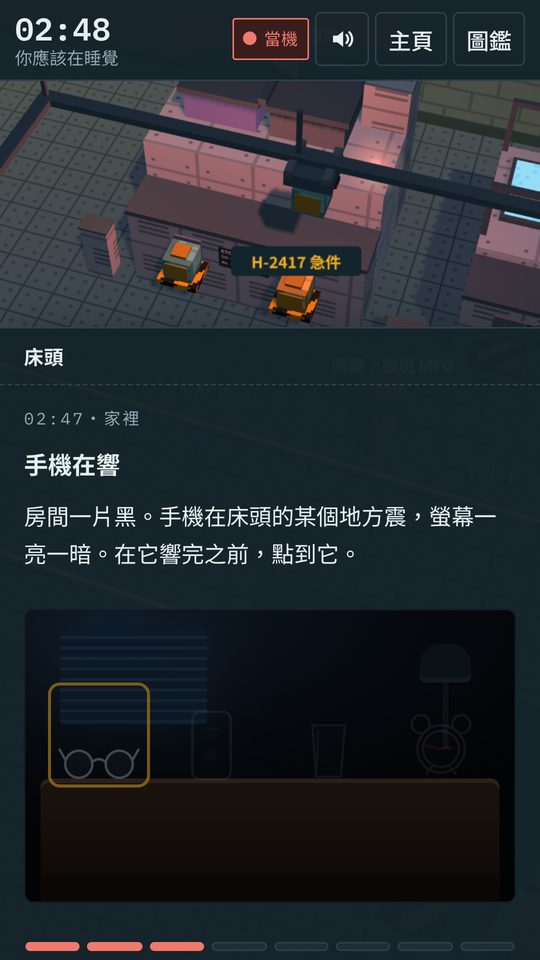
fab24hr's A day in the fab is built around this: depending on when you open the site, you land in the late-night, morning, afternoon or evening shift. The late-night shift starts with a phone call at 02:47: an etch tool has gone down with a hot lot stuck inside. The companies, people, lot numbers and figures in the game are fictional; why fabs never stop and how shifts work come from public, general sources. For a full timeline of the day, read A day in the life of a fab engineer.
In fab24hr, A day in the fab drops you into the late-night, morning, afternoon or evening shift depending on when you open the site. The late-night shift starts with a phone call at 02:47.
Clock in, starting from your current timeMore articles
The life of a chip: a new main story that follows one chip from the R&D line to someone's hands
Why is the lithography area in a chip fab yellow?
Why do chip fab workers wear full bunny suits?
- What is fab24hr?: the two ways to play, the four shifts, common questions, sources
- The life of a chip: how chips are made: tape-out, pilot run, mass production, wafer test, packaging, shipping
- A day in the life of a fab engineer: who does what (PE, EE, PIE, manufacturing), and the day hour by hour
- Who works in a chip fab: technicians, manufacturing, process, equipment, litho, facilities, integration, R&D, the chief, the vendor, and test and packaging at the test-and-assembly house: each role's day
- Chip fab jargon in plain English: MO, Hold, Q-time, OCAP and the rest, one plain sentence each
- fab24hr in the classroom: 20- and 40-minute lesson plans, one chapter of the main story per lesson, discussion questions, devices and privacy
- About and press kit: trailer, gameplay clips, descriptions and key facts