Is working in a semiconductor fab hard? Shifts, on-call and hours
Is working in a chip fab hard? It depends a lot on which job you do and which period you land in. A fab runs 24 hours a day, so most people on the production line work shifts, commonly 12 hours long, alternating days and nights. Many engineers who work days take turns being on call, and when a tool has a problem at night, their phone rings. Stretches when new tools are moving in, a new process is starting up or yield has a problem are much busier than usual. This article doesn't call it good or bad. It lays these things out so you can judge for yourself.
Why is fab work often called exhausting?
- The tools never stop, and problems don't keep hours: for why, see Why do chip fabs run 24 hours a day? The tools are always running, so a breakdown or an alarm can come in the middle of the night, on a weekend or on a holiday.
- Many things need someone on site: where the tool stopped and what happened to the wafers inside often take someone at the tool to see. A click from home isn't always enough.
- Tool time is contested: the same tool runs production, and engineers need it too, to track down problems and run experiments.
- Things pile up in one day: a common description goes like this. In the morning, check the overnight alarms and the handover, then report yesterday's data at the morning meeting; in the afternoon, run experiments and sit in cross-team meetings; in the evening, sort through data and write reports. When any tool has a problem along the way, everything planned gets pushed back.
An academic study of working time in wafer fabs explains the third point. Technicians' work is mostly predictable: a task comes in, gets handled, and is done. Engineers, by contrast, often carry several problems of different lengths at once. Troubleshooting and experiments both need tools, but when a tool is free is mostly scheduled by the people in charge of production, so engineers often have to wait. The study concludes that this way of dividing up time, shaped by the technology itself, makes engineers' hours long.
How do the shifts work?
The line has to be staffed around the clock, so technicians and Manufacturing staff mostly work shifts. One common pattern is 12-hour shifts with four crews: at any time, one crew works days, one works nights and two are off. In Taiwan this is often called "four crews, two shifts"; "two days on, two days off" means each person works two days and then rests two, and some patterns mix in three days on and three days off. Workdays are long, but there are also many days off.
Some people stay on days or on nights; others swap between days and nights every so often. The details differ from fab to fab. Guidance from occupational safety and health agencies also points out that 12-hour shifts call for more rest days, and enough unbroken time off between shifts to get enough sleep.
Do engineers work shifts too? What is on-call?
Engineers mostly work days, but they take turns being on call: on your days, you keep your phone on after work, and when the night shift runs into something that needs a decision, the first call goes to you. For example, a tool goes down, a measurement is out of spec, or a lot may need to go on hold.
Often the night call isn't asking for an answer. It's asking for an instruction that keeps things from getting worse: stop the tool, put the lot on hold, find the cause in the morning. Some situations do need someone to come in. In some roles, engineers work shifts too.
When does it get especially busy?
- New tools moving in: each one has to be moved in, hooked up to water, power and gas, tuned and qualified before production can start.
- A new process or product starting up: conditions are tried one round at a time, and every round means waiting for results before the next step.
- A yield problem: someone has to dig through piles of data to find which step and which tool went wrong.
- A tool down with lots stuck: the queue behind it keeps growing, and everyone asks "when will it be up?"
- A customer rush: hot lots cut in, and schedules, tools and people all have to shift.
These don't happen every day, but when one hits, those weeks get long.
Every role has its own rhythm
Busy times differ by role too (for what each one does, see Who works in a chip fab):
- Technicians, Manufacturing: mostly on shifts, with fixed times to take over and hand over; when a tool lights up, the rules say stop it first and report it.
- Process engineers, equipment engineers: mostly day shifts plus on-call, and busiest when a tool has a problem. For how the two differ, see What's the difference between a process engineer and an equipment engineer?
- Facilities: the whole fab's water, power, gases and chemicals are watched from the control room around the clock, so some people work nights.
- Process integration, Production control: they look at whole lots and the whole line; when a tool stops, they have to answer "how late will the lots be?"
- R&D integration engineers: the first lots of a new product are watched at every step, and calls can come at night.
How can you tell if it's right for you?
Instead of asking "is it tiring?", ask concrete questions in interviews or when you talk to people who work there:
- Does this job involve shifts? Which pattern?
- How often are you on call? When you are, how often do you have to go in?
- If there are shifts, how often do days and nights swap? How long until you move to a day position?
- Is the department installing new tools or pushing a new process right now?
You can also ask yourself: when you're woken in the middle of the night, can you think clearly fast? Do you like juggling several things at once? If it's hard to picture, spend a day in the game first.
In fab24hr
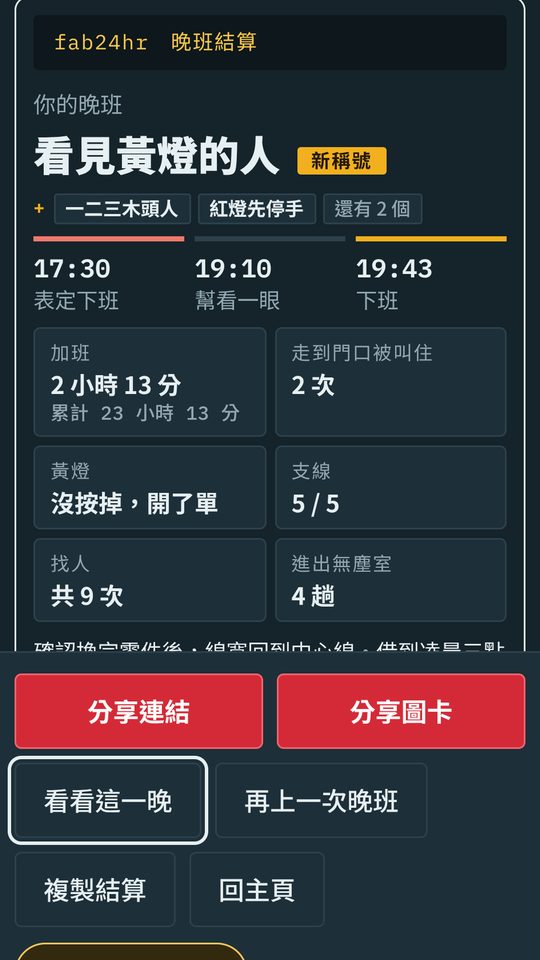
In fab24hr's A day in the fab, the process engineer's late-night shift starts with a phone call at 02:47: an etch tool has gone down with a hot lot stuck inside. You're at home and can't see the tool, so you have to ask the night shift over the phone to check for you. The morning shift is firefighting at the fab; in the afternoon you rework one wafer by hand and write an incident report. The evening shift is called "Almost Out the Door": the official clock-out is 17:30, and you get stopped again and again. At one point you reach the door and someone behind you calls your name. You can turn around, or choose "Leave now, deal with it tomorrow": the shift ends there, and someone is waiting outside the fab gate to have dinner with you. What you didn't finish is listed on the recap card, and the 02:47 call will still come.
The companies, people, tools and lot numbers in the game are fictional, and to keep it fun, several things happen on the same day. Shifts and on-call are written from public, general sources. To see what everyone does on the same day, read A day in the life of a fab engineer; more articles like this are in Working in a fab.
Where you'll meet it in the gamePlay the process engineer in A day in the fab: the late-night shift starts with the 02:47 call, and in the evening shift, "Almost Out the Door", you never quite get out, or you can choose "Leave now, deal with it tomorrow". Chapters 6 to 9 of The life of a chip are the same day.
Be a process engineer in fab24hr: the 02:47 call, the morning firefighting, the afternoon fix, and an evening door you just can't get through.
Play as a process engineer, starting with the shift you're in nowTeachers: this article can go with "fab24hr in the classroom" in class.
More articles
Which degrees work in a chip fab, and what does each one do there?
VLSI design vs working in a fab: what's the difference?
What does QA (quality assurance) do in a chip fab?
What does production control do in a chip fab, and how are due dates set?
- What is fab24hr?: the two ways to play, the four shifts, common questions, sources
- The life of a chip: the life of one chip: tape-out, pilot run, mass production, wafer test, packaging, shipping
- A day in the life of a fab engineer: who does what (PE, EE, PIE, manufacturing), and the day hour by hour
- Who works in a chip fab: technicians, Manufacturing, process, equipment, Facilities, integration, QA, production control, masks, R&D, the chief, the vendor, and test and assembly at the test-and-assembly house: each role's day
- Chip fab jargon in plain English: MO, Hold, Q-time, OCAP and the rest, one plain sentence each
- Chip fab machines, taken apart: What 25 chip fab machines do (etch, scanner, CMP, furnace, packaging…), each as a 3D model to take apart
- fab24hr in the classroom: Semiconductor lesson plans: 20/40-minute plans, a lesson per chapter or process area (3D machines, the game, articles), discussion questions, a worksheet, FAQ
- About and press kit: trailer, gameplay clips, descriptions and key facts