← Semiconductors 101: a free course following the life of a chip
Semiconductors 101, unit 8
Wet clean: washing wafers between steps
Every step leaves something invisible on the wafer surface, and the next step needs a clean surface. Cleaning is one of the most repeated steps in the whole flow: clean too little and the next layer grows badly; clean too much and what's eaten away can't be put back.
Goals
- Name the four kinds of things a wet clean removes, and what each one does if it stays.
- Explain the stages of the common standard clean and what each one removes, why every chemical is followed by an ultrapure-water rinse, and what tank-by-tank batch cleaning and one-wafer-at-a-time spraying are each good at.
- Explain how concentration, temperature and time set how hard a clean works, why cleaning too long is a problem too, and why a cleaned wafer can't wait long.
Step by step
- Clean before and after almost every major step, starting from what the last step left behind.
WhyEvery step leaves particles, organics or metal, and every next step has its own worries.
If notDirt travels on to the next step: one particle can break a line or join two lines together.
- Remove organics and particles with an alkaline mix first, then metals with an acidic mix.
WhyDifferent dirt needs different chemicals, just as grease and rust stains are washed differently.
If notMetal left on the surface moves into the silicon in the heat, and transistors leak.
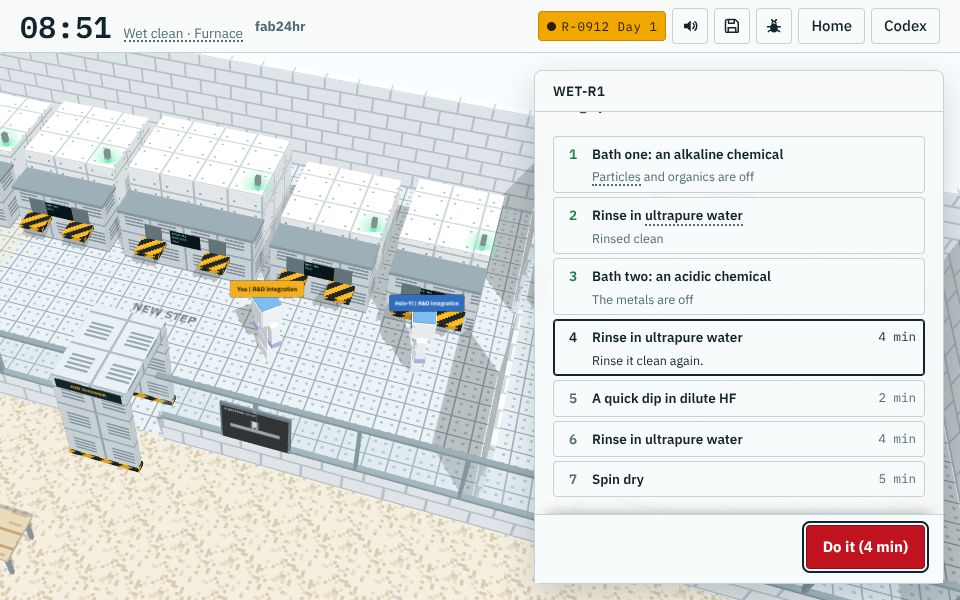
A screen from the game fab24hr; the tools, lot numbers and people are fictional. Play this part in the game → - Rinse with ultrapure water after every chemical, then dry.
WhyThe chemicals have to be rinsed off, and this water is the last liquid to touch the wafer.
If notWhatever is in the water stays on the wafer, and uneven drying leaves ring-shaped water marks.
- Set concentration, temperature and soak time in advance where the dirt comes off and the least surface is eaten, and run them by the recipe.
WhyCleaning is a light etch too: the harder it works, the more of the surface it eats.
If notToo long or too strong a clean thins the layer underneath, and what's eaten can't be put back.
- Top up the chemicals on schedule, change the whole bath at its count, and run monitor wafers.
WhyThe chemicals change on their own, and the more lots a bath cleans, the more dirt it holds.
If notWithout changes, some of the dirt in the tank lands back on wafers; without measuring, a drifting tool goes unseen.
- Send the cleaned wafer to the next step within its time limit (Q-time).
WhyClean silicon left waiting grows its oxide back and picks things up from the air.
If notPast the limit, mild cases are cleaned again, and some wafers are scrapped.
What you adjust, what can go wrong
- Soak time
ChangesThe longer the soak, the harder the clean, and the more of the surface is eaten.
If it is offToo long, and the layer underneath that should stay untouched gets thinner; what's eaten can't be put back.
- Chemical concentration and temperature
ChangesA bit stronger or hotter cleans harder.
If it is offToo strong or too hot does what too long does: it thins the layer underneath and roughens the silicon surface.
- Which chemicals (alkaline, acidic, dilute HF)
ChangesThe alkaline mix removes organics and particles, the acidic mix removes metals, and very dilute hydrofluoric acid removes native oxide.
If it is offLeave out the right one and that kind of dirt stays: metal carried into the furnace gets baked into the silicon.
- When to change the bath (after how many lots)
ChangesA complete change clears out what earlier lots left behind in the tank.
If it is offToo late, and dirt builds up in the tank and some of it lands back on wafers.
- Time limit to the next step (Q-time)
ChangesSets how soon after cleaning the wafer must start the next step.
If it is offWait too long and the oxide grows back and dirt sticks; mild cases are cleaned again, some are scrapped.
Key ideas
Why clean before and after almost every step?
A wet clean uses chemicals between steps to wash invisible dirt off the wafer surface, then rinses it with ultrapure water (almost nothing but water molecules) and dries it. Four kinds of things come off: tiny particles, organic residue, metals, and native oxide, the layer only a few atoms thick that silicon grows on its own when it meets air and water. A chip is built up layer by layer; every step leaves a little something behind, and the next step needs a clean surface. The finest lines are a few tens of nanometers wide or less, so one particle landing on them can break a line or join two lines together. The cleanroom keeps particles out of the air, but wafers still pick them up going in and out of tools and sitting in chemicals, so before a wafer is finished, it goes through a wet clean tool many, many times.
Four kinds of dirt, a different chemical for each
Just as grease and rust stains on laundry need different treatments, so does the dirt on a wafer. The common standard clean takes off organics and particles first, then metals. First comes a hot alkaline mix (ammonia, hydrogen peroxide and water): the hydrogen peroxide breaks down organics, and the surface is etched very lightly too, so particles stuck to it come loose. Second comes an acidic mix (hydrochloric acid, hydrogen peroxide and water), which dissolves the metals. When the native oxide has to go, a step of very dilute hydrofluoric acid is added. Each kind gets its own treatment because no one chemical removes them all, and each does its own damage if it stays: organics keep the next layer from growing well or sticking; metals move into the silicon at high temperature and make transistors leak; and native oxide is kept as protection at some steps but has to come off at others, so the next layer sits directly on clean silicon.
Inside the tool: tank after tank, or one wafer at a time
A batch wet clean tool takes a whole lot through a row of tanks in order: chemical, ultrapure-water rinse, the next chemical, another rinse, then dry, so it cleans many wafers at once. A single-wafer tool cleans one at a time: the wafer spins in a small enclosed space while nozzles spray chemicals and ultrapure water onto it, then it spins dry at high speed. What comes off one wafer is less likely to reach the next, and conditions are easier to control, but it takes more tools. Either way, the last liquid to touch the wafer is the rinse water (some dryers then use a little alcohol vapor to carry it off), and whatever is in the water can stay on the wafer, so it is always ultrapure water. If the water doesn't dry evenly, it also leaves ring-shaped water marks.
Concentration, temperature, time: just enough, not as long as possible
How hard a chemical cleans depends on three things: how concentrated, how hot and how long. A bit stronger, hotter or longer cleans harder but also eats more of the surface, because cleaning is usually a very light etch as well. Soak too long or use too strong a mix, and the layer underneath that shouldn't be touched gets thinner, or the silicon surface turns rough, and what's eaten away can't be put back. Each clean removes only a tiny amount, but a wafer is cleaned many times and lines keep getting finer, so it adds up and has to be counted. So the goal is just enough: the dirt comes off, and the layer underneath ideally doesn't change at all. That is also how cleaning differs from wet etch: wet etch wants to remove a layer of material, while cleaning only wants the dirt gone.
The chemicals change, so top up, change and measure on schedule
The trouble is that the chemicals change on their own. In a heated bath, hydrogen peroxide slowly breaks down and ammonia escapes bit by bit, and the more lots a bath has cleaned, the more of what it washed off stays in the tank, and some of it lands back on wafers. So concentration, temperature and soak time go into the recipe (the settings the tool follows), chemicals are topped up on schedule, and the bath is changed completely after a set number of lots. Monitor wafers (wafers that never ship, used only to check the tool) also run on a schedule to measure how much was removed and how many particles were added; the numbers go on a control chart to see whether they still look like usual, and when they drift, someone stops to find out why. The rinse water is watched too: resistivity meters on the pipes, which show how pure it is, measure all the time, and a drop means ions have got in.
Before and after: what the last step left, what the next step fears
Each clean deals with something different. After etch and resist strip, residue and leftover photoresist must not travel on to the next step. After CMP, the slurry is full of tiny abrasive particles, so the wafer is cleaned right away. Before the furnace, the clean has to be thorough, because metals and organics on the surface get baked in by the heat and the oxide comes out worse. Before thin film, a dirty surface means the new film doesn't grow evenly. A cleaned wafer can't wait long, either: clean silicon in air slowly grows its oxide back and picks things up from the air, so there is a time limit before the next step, called Q-time. Past it, mild cases are cleaned again and some wafers are scrapped, so when the next tool isn't ready, it is often better not to clean yet.
Common misconceptions
- People sayCleanrooms are so clean that wafers hardly need washing.
- In factThe cleanroom keeps particles out of the air, but etch residue, photoresist and polishing grit stay on the wafer, and wafers pick things up going in and out of tools, so one wafer is cleaned many, many times before it is finished. Longer isn't better, either: the chemicals also eat a little of the surface, what is eaten can't be put back, and the aim is just enough.
- People sayCleaning just means rinsing the wafer with water.
- In factThe four kinds of dirt each need their own chemical: an alkaline mix for organics and particles, an acidic mix for metals, and very dilute hydrofluoric acid for native oxide. Water is the rinse after each chemical, and it has to be ultrapure water, almost nothing but water molecules: it is the last liquid to touch the wafer, and whatever is in it can stay behind.
Look: machines to take apart
 Batch wet bench
Read
Play
Think
- A batch tool cleans many wafers at once; a single-wafer tool cleans one at a time and is less likely to carry dirt from one wafer to the next. If you had to choose one for a certain step, what would you ask first?
- A cleaned wafer has a time limit, but the next tool may go down, be in maintenance, or have hot lots queued ahead. Should the next lot be cleaned now? What does each choice cost?
Teaching materials: slides
The key ideas, diagram, machines and questions of this unit as a slide deck, ready to project or to put into your own handouts.
Download slides (PPTX)180 KBDownload slides (PDF)219 KB
Free to use in class and for non-commercial teaching. Please credit fab24hr. Do not sell it or present it as your own work. Spot a mistake? Report it
Cite this article"Semiconductors 101, unit 8:Wet clean: washing wafers between steps" fab24hr, updated . https://fab24hr.com/en/learn/cleaning/