What do the seven process areas of a chip fab do?
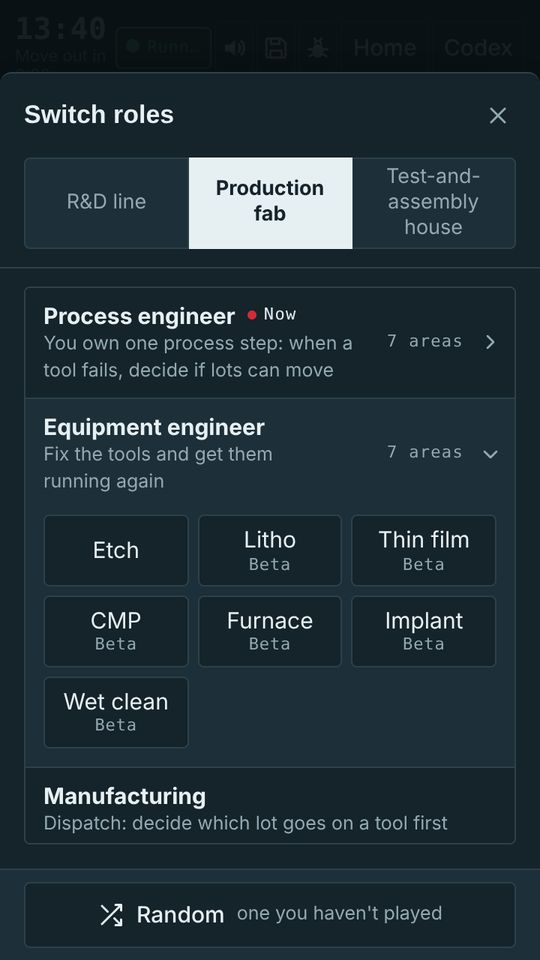
The front end of a wafer fab is often split into seven process areas: litho prints the circuit pattern, etch cuts it in, thin film adds a new layer of material, CMP polishes the surface flat, the furnace grows oxide or repairs the crystal at high temperature, implant shoots atoms into the silicon, and wet clean washes the surface between steps. Tools that do the same job sit together, and that is an area. A wafer goes back and forth between these areas through hundreds of steps before it becomes a chip built up layer by layer.
Why split a fab into areas?
Because a chip isn't made in one go; it is stacked up one layer at a time. The basic rhythm for one layer is roughly: grow a layer of material (thin film or furnace), print this layer's pattern (litho), remove what the pattern doesn't protect (etch), shoot in atoms where needed (implant), wash (wet clean), polish flat (CMP), then start the next layer. After dozens of layers, every area has seen the wafer many times. Putting tools that do the same thing together makes conditions easier to control and the work easier to divide.
What happens in litho?
Lithography coats the wafer with photoresist, shines light through a photomask in a scanner, then develops it, leaving the circuit pattern printed in the resist. The room's light is yellow because photoresist reacts to blue and shorter wavelengths. How sharp the pattern is, and whether it lines up with the layer below (overlay), is what litho worries about most. Play as a litho engineer · Play as the litho equipment engineerWhat happens in etch?
Etch removes the material the resist doesn't cover, cutting the pattern into the layer below. Fine patterns are mostly cut with plasma ("dry etch"), which can go straight down and deep; there is also "wet etch" with chemicals, which eats in every direction at once. Too little and holes don't open; too much and the layer underneath is damaged. Play as the etch process engineer · Play as the etch equipment engineerWhat happens in thin film?
The thin film area grows very thin layers of insulator or metal on the wafer, from a few nanometers to a few hundred nanometers thick. Three common ways: let gases react on the surface (chemical vapor deposition, CVD), knock atoms off a target with plasma so they land on the wafer (physical vapor deposition, or sputtering), or grow one atomic layer at a time (atomic layer deposition, ALD), which even coats deep, narrow holes. This area cares about how thick and even the film is, and whether there are particles. Play as the thin film process engineer · Play as the thin film equipment engineer
What happens in CMP?
CMP is chemical mechanical planarization. Every new layer leaves the surface uneven; the slurry softens the surface while a spinning pad grinds it flat. Once it's flat, the next litho step can line up properly. For metal wiring, CMP also polishes away the extra metal so it stays only in the trenches. Too little leaves residue; too much thins the wires. Play as the CMP process engineer · Play as the CMP equipment engineerWhat happens in the furnace (diffusion) area?
A furnace holds a whole batch of wafers on a rack and slides them into a long, very hot tube, often more than a hundred at a time. Many fabs call this the diffusion area and the tubes diffusion furnaces. It grows oxide, uses heat to settle implanted atoms into place and repair the disturbed crystal, and some films are grown there too. Temperature and time decide the result, and the effect of heat keeps adding up (the thermal budget). When a furnace run goes wrong, the whole batch goes wrong. Play as the furnace process engineer · Play as the furnace equipment engineer
What happens in implant?
Ion implantation turns atoms such as boron or phosphorus into charged ions, speeds them up with an electric field and drives them into the silicon, deciding which regions conduct and how well. This is doping, and the atoms are called dopants. How many go in (the dose) sets how much it conducts; how fast they go in (the energy) sets how deep. A heat step usually follows to settle the atoms and repair the crystal. Atoms that went into the wrong place can't be taken out, so this area dreads a wrong setting. Play as the implant process engineer · Play as the implant equipment engineerWhat happens in wet clean (wafer cleaning)?
Between steps, wet clean uses chemicals to remove particles, organic residue, metals and the very thin native oxide from the surface, then rinses with ultrapure water and spins the wafer dry. It is one of the most repeated steps in the whole flow. A freshly cleaned surface changes if it waits too long, so there is often a time limit between cleaning and the next step (Q-time). Play as the wet clean process engineer · Play as the wet clean equipment engineer
Where does measurement happen?
Almost every area measures after it works: film thickness, line width, alignment, particles. Some metrology tools sit next to each area, some are grouped together; results go onto control charts, and when they drift, someone has to act. Each area usually has a process engineer who owns whether the output is right and an equipment engineer who keeps the tools running. For how they split the work, read What's the difference between a process engineer and an equipment engineer?.
In fab24hr
In fab24hr, the production fab and the R&D line are both split into these seven areas, each with a process role and an equipment role: tap "Clock in", choose "A day in the fab", then tap "Switch roles" and pick the place, the job and the area. The yellow light in litho, a hundred-plus wafers in one furnace load, and implanted atoms that can't come back out all follow public, general sources; tool numbers, lot numbers, figures and people are fictional and do not describe any company's practice.
Where you'll meet it in the gameThe production fab and the R&D line are both split into these seven areas, each with process and equipment roles: the process engineer owns whether the output is right, the equipment engineer looks after the tools.
In fab24hr, all seven areas have process and equipment roles. Pick one and spend a day as its engineer.
Play as the CMP process engineerMore articles
What's the difference between a process engineer and an equipment engineer?
Is a PE a process engineer or a product engineer?
Why are wafers round?
What is Q-time, and why can't wafers wait?
- What is fab24hr?: the two ways to play, the four shifts, common questions, sources
- The life of a chip: how chips are made: tape-out, pilot run, mass production, wafer test, packaging, shipping
- A day in the life of a fab engineer: who does what (PE, EE, PIE, manufacturing), and the day hour by hour
- Who works in a chip fab: technicians, Manufacturing, process, equipment, Facilities, integration, QA, production control, masks, R&D, the chief, the vendor, and test and assembly at the test-and-assembly house: each role's day
- Chip fab jargon in plain English: MO, Hold, Q-time, OCAP and the rest, one plain sentence each
- fab24hr in the classroom: 20- and 40-minute lesson plans, one chapter of the main story per lesson, discussion questions, devices and privacy
- About and press kit: trailer, gameplay clips, descriptions and key facts